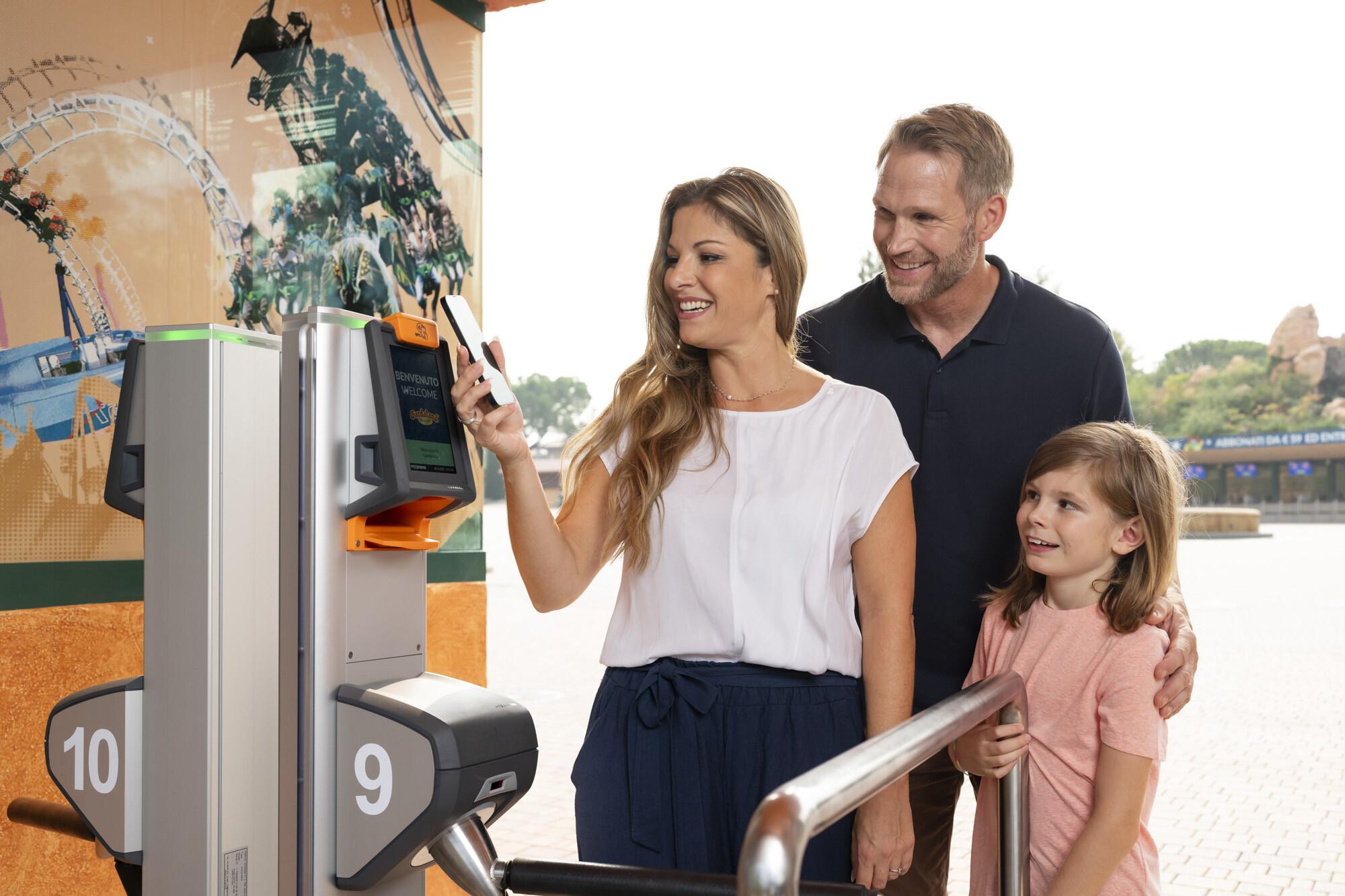
A turnstile access control system helps entertainment venues manage visitor entry through automated gates, access readers, and ticket validation software. Instead of relying entirely on staff to check tickets manually, operators can verify visitor credentials and control passage at designated entrances. For amusement parks, family entertainment centers (FECs), and other leisure venues, the right system can improve entrance efficiency, organize visitor flow, and connect admission control with daily operations.
What Is a Turnstile Access Control System?
A turnstile access control system combines physical entrance gates with electronic access verification. It allows authorized visitors to enter a venue after presenting a valid ticket, card, wristband, or other supported credential.
Unlike a standalone turnstile that simply restricts physical passage, an integrated access solution connects the gate with readers, controllers, and management software. The system checks whether a visitor has permission to enter before unlocking the passage.
For entertainment venues, this permission may depend on several factors:
- Whether the ticket or membership is valid
- Whether the ticket has already been used
- Whether the visitor has access to a specific area
- Whether the ticket is valid for the selected date or time
- Whether the credential matches the venue's admission rules
Depending on the system configuration, access records can also help operators review visitor activity and manage entrance operations.
How Does a Turnstile Access Control System Work?
An automated entrance process generally involves four steps.
1. Visitor Presents a Credential
Visitors approach the entrance and present an accepted credential to the reader. Common options include:
- QR code tickets displayed on mobile phones
- Printed barcode tickets
- RFID cards
- RFID wristbands
- Other compatible access credentials
The available options depend on the reader, controller, and software configuration.
2. The System Validates Access
The reader captures the credential information and sends it to the access control software or connected controller.
The system checks the relevant admission rules, such as ticket validity, access permissions, and usage status. If the credential meets the configured requirements, the system authorizes entry.
3. The Turnstile Opens
After successful verification, the access controller sends an opening signal to the gate. The visitor can then pass through the entrance.
If access is rejected, the gate remains locked or displays an indication that the credential cannot be accepted.
4. Entry Information Is Recorded
Depending on the software and integration, the system may record successful and unsuccessful validation attempts, entry times, and relevant credential information.
These records can support visitor management, attendance reporting, and operational reviews.
The complete process connects ticket validation with physical access control, reducing the need for staff to manually inspect every ticket.
Common Types of Turnstile Gates
Different venues have different requirements for visitor flow, security, space, and accessibility. Choosing the right gate is an important part of planning an entrance solution.
1. Tripod Turnstiles
Tripod turnstiles use three rotating arms to control pedestrian passage. They are commonly used in facilities that need a compact and clearly defined entry lane.
Typical applications include:
- Indoor entertainment centers
- Fitness facilities
- Staff-only entrances
- Controlled-access areas
Their relatively compact design can be useful where entrance space is limited. However, operators should consider whether the physical barrier is suitable for children, families, and visitors with mobility needs.
2. Flap Barrier Turnstiles
Flap barriers use retractable panels that open after successful verification. They provide a more modern entrance appearance and are often used in facilities that need organized pedestrian access.
They may be suitable for:
- Theme parks
- Amusement attractions
- Commercial entertainment venues
- High-traffic entrance areas
The lane width, opening speed, sensor configuration, and emergency-release behavior should be evaluated before installation.
3. Swing Gate Turnstiles
Swing gates use movable panels to create a passage. Compared with narrow access lanes, they can provide more flexible passage arrangements.
They are particularly worth considering when a venue needs to accommodate:
- Families with young children
- Wheelchair users
- Strollers
- Visitors carrying equipment or larger items
For an entertainment venue, accessibility should be considered during the initial entrance layout rather than added as an afterthought.
4. Full-Height Turnstiles
Full-height turnstiles create a more enclosed passage and provide stronger physical separation between controlled and uncontrolled areas.
They are generally more suitable for locations with stricter access requirements. However, their size and enclosed design may not fit the customer experience expected at every family entertainment venue.
The best option depends on the venue's operating environment, visitor profile, available space, and access-control objectives.
Key Features to Consider
When evaluating a turnstile access control system, operators should look beyond the gate itself. The verification technology, software connection, and entrance workflow are equally important.
Multiple Credential Options
Different venues use different admission methods. Some sell QR code tickets, while others issue RFID cards or wristbands.
A suitable solution should support the credential types required by your business. If you plan to accept both online tickets and physical cards, confirm that the readers and software can handle both.
Ticket Validation
Ticket validation determines whether a visitor is authorized to enter.
Important questions include:
- Can the system check ticket validity?
- Can it prevent the same single-entry ticket from being reused?
- Can it support different admission categories?
- Can it apply date-based or time-based access rules?
Not every system supports every rule by default, so these capabilities should be confirmed with the supplier.
Access Control Software
The software connects entrance devices with admission rules and operational records.
Depending on the solution, it may support credential management, access permissions, validation records, and entrance reporting.
For venues with multiple entrances or controlled areas, it is important to understand how permissions are configured and managed.
Integration with Ticketing Systems
A turnstile becomes more useful when it works with the venue's ticketing workflow.
For example, a visitor may purchase an admission ticket at the counter or through an online booking channel. The ticket is then issued as a QR code, barcode, or another supported credential. At the entrance, the reader verifies the ticket before allowing passage.
This connection can reduce repeated manual checks and create a more consistent admission process.
Integration with Other Venue Systems
For larger entertainment businesses, entrance management may need to work alongside other operational systems, such as:
- Ticketing and admission management
- POS and payment systems
- Membership management
- RFID card management
- Visitor reporting
The exact integration scope varies by supplier. Operators should clarify whether the connection is native, API-based, or requires additional development.
Benefits for Amusement Parks and FECs
Faster and More Organized Visitor Entry
Manual ticket inspection can become difficult when many visitors arrive at the same time.
Automated validation allows visitors to present their credentials at designated entrance lanes. This can help reduce repetitive manual checks and organize the admission process.
Better Control Over Ticket Usage
A connected validation process can check whether a ticket meets the venue's admission rules before opening the gate.
This helps operators manage single-entry tickets, different admission categories, and other configured access permissions.
Improved Visitor Experience
Visitors generally want to enter a venue without unnecessary delays or confusing procedures.
A clear entrance process, easy-to-use readers, and appropriately selected gates can make admission more convenient for families and other guests.
More Useful Operational Records
Digital validation records can provide information about entrance activity, depending on the system's reporting capabilities.
Operators may use this information to review visitor traffic patterns, understand busy periods, and plan staffing arrangements.
A More Connected Venue Operation
When entrance management is integrated with ticketing and other venue systems, operators can reduce disconnected workflows.
Instead of treating admission as an isolated process, the entrance can become part of a broader digital management environment.
How to Choose the Right Turnstile Access Control System
Before purchasing equipment, evaluate the following factors.
1. Understand Your Venue Type
A small indoor arcade, a family entertainment center, and a large amusement park have different entrance requirements.
Consider your daily visitor volume, peak-hour traffic, entrance layout, visitor demographics, and whether access needs to be controlled across multiple areas.
2. Select the Appropriate Gate Type
Choose the physical gate based on the passage experience you want to create.
Tripod turnstiles may suit compact controlled entrances, while flap barriers and swing gates may be more appropriate for certain public-facing entertainment venues.
Also consider accessible passage lanes and emergency evacuation requirements.
3. Confirm Credential Compatibility
List the admission methods your venue currently uses or plans to introduce.
Ask the supplier whether the proposed readers can recognize your QR codes, barcodes, RFID cards, or wristbands. Confirm the supported card technology and any hardware or software requirements.
4. Check Software Integration
A gate that operates independently may not provide the complete operational workflow your venue needs.
Confirm how the turnstile connects to your ticketing or access management software, how validation rules are configured, and whether entry records can be accessed centrally.
5. Evaluate Installation and Maintenance
Before installation, review the entrance dimensions, power supply, network connectivity, mounting requirements, and environmental conditions.
For outdoor or water-related environments, check whether the equipment is suitable for the expected exposure to weather and moisture.
You should also clarify warranty coverage, spare parts availability, technical support, and maintenance procedures.
6. Plan for Future Expansion
Your venue may add new entrances, attractions, membership programs, or ticket types over time.
Choose a solution that can accommodate your expected operating model. Ask about expansion options and the cost of adding readers, gates, or software integrations.
Common Mistakes to Avoid
Choosing an entrance system based only on the gate's appearance or purchase price can create problems later.
Common mistakes include:
- Ignoring software compatibility: A reader may not work with your existing ticketing platform without additional integration.
- Choosing the wrong gate type: A narrow passage may not suit family visitors or people with mobility requirements.
- Overlooking peak-hour traffic: Entrance capacity should be considered alongside expected visitor volume.
- Assuming all readers support the same credentials: QR codes, barcodes, and RFID technologies require compatible hardware and software.
- Forgetting maintenance requirements: Installation conditions, spare parts, and technical support affect long-term operation.
A complete evaluation should consider the gate, reader, controller, software, and actual visitor journey together.
Frequently Asked Questions
What is the difference between a turnstile and an access control system?
A turnstile is the physical gate that controls pedestrian passage. An access control system manages the verification and authorization process that determines whether someone can enter. They can work together as one integrated entrance solution.
Can a turnstile access control system scan QR code tickets?
Yes, compatible systems can use QR code readers to validate digital or printed tickets. However, the reader, controller, and ticketing software must support the required QR code format and validation workflow.
Can RFID cards or wristbands be used with turnstiles?
Yes. RFID-compatible readers can identify supported cards or wristbands. This can be useful for venues that use RFID credentials for admission, memberships, or other visitor services.
Are turnstile systems suitable for family entertainment centers?
Yes. FECs can use automated entrance gates to manage ticket validation and visitor access. Gate selection should consider children, families, accessibility, visitor flow, and the venue's admission model.
Can turnstiles integrate with a ticketing system?
They can, provided the gate controller, reader, and ticketing platform are compatible. Integration allows the system to validate admission credentials and trigger the gate when access is approved.
What should I ask a supplier before buying?
Ask about gate types, supported credentials, ticket validation rules, software integration, installation requirements, accessibility, maintenance, warranty, and future expansion.
Final Thoughts
A turnstile is more than a physical barrier at the entrance. When connected with access control and ticketing software, it becomes part of a venue's visitor management process.
For amusement parks, arcades, and family entertainment centers, the right solution should match the venue's admission model, visitor flow, and operational requirements. Evaluate the complete system—not just the gate—to build an entrance process that is reliable, convenient, and ready to support future growth.